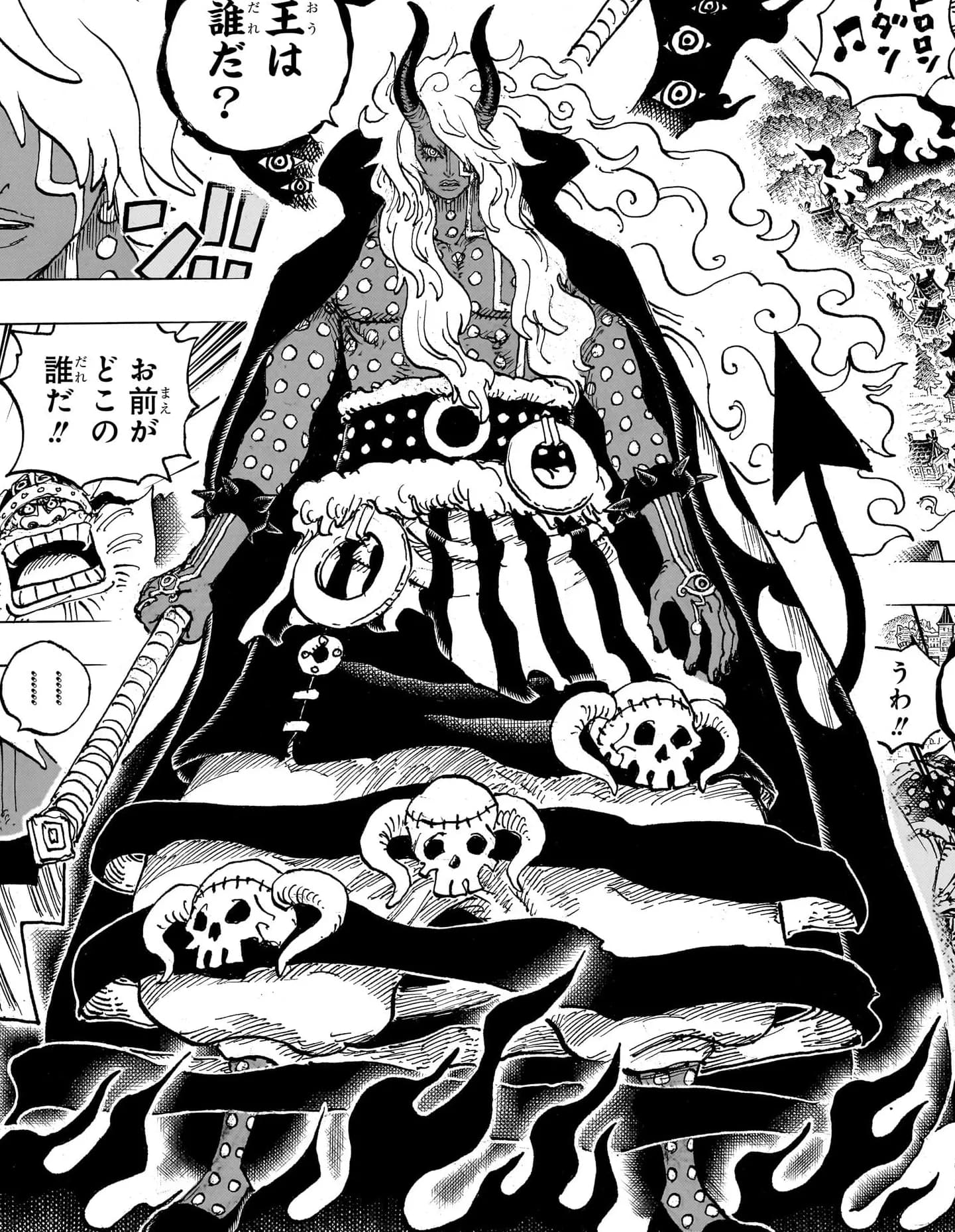
Imu Is Nerona Imu, the Immortal Survivor of the First Twenty
Chapter 1086 supplies the name, chapter 761 supplies a plausible route to immortality, and the Empty Throne supplies the motive for eight centuries of secrecy.
 Same mystery83% confidenceLineage Factor is the sole power system of One Piece and Imu's real weapon
 Same mystery68% confidenceImu's true form is pathetic and resembles Stelly
 Same mystery0 evidenceNERONA IMU Has the Mythical HUMAN HUMAN fruit model 20 KINGS
 Also in this lore61% confidenceThe One Piece is the return of the Ancient Kingdom!
 Also in this lore65% confidenceTHE FAILED WORLD THEORY
 Also in this lore84% confidenceMythical Hito Hito no Mi: Model Zaza
 Also in this lore75% confidenceThe Man Marked by Flames, Vander DeckenAlso in this lore75% confidenceThe Man Marked By Flames Is The Last God's Knight
 Also in this lore90% confidenceCHURCHWARD'S "SACRED SYMBOLS OF MU" REVEALS THE GREAT KINGDOM'S NAME, THE "D" MYSTERY, AND THE END OF ONE PIECE
 Also in this lore80% confidenceMy Blackbeard theory: The Man of Two Worlds
Hi, admin of LoreSquare.com here. This post is a quick demo of what the site can do. Ideas or feedback? Leave them in the discussion below — we read everything.
Chapter referenceSOURCE · Ch. 1086Ch. 1086 · One Piece Chapter 1086, pages 7-8: The Five Elder Planets · pp. 8–13Ivankov connects the hidden ruler to Saint Imu of House Nerona, one of the First Twenty, and raises the immortality operation as the explanation for an impossible lifespan. Chapter referenceSOURCE · Ch. 761Ch. 761: The Ope-Ope Fruit · Page 8Doflamingo explains that the Ope Ope no Mi can perform the Perennial Youth Operation at the cost of the user's life.Imu did not inherit the Empty Throne. Imu survived the Void Century. This theory tests the most economical way to connect the name, the medical mechanism, and the political lie.
Working thesis: the present ruler is Saint Imu of House Nerona, preserved for eight centuries by the Ope Ope no Mi's Perennial Youth Operation.
Evidence map
| Claim | Manga source | What it establishes |
|---|---|---|
| Identity | Chapter 1086 | Ivankov connects the throne-room Imu to a named member of the First Twenty. |
| Mechanism | Chapter 761 | The Ope Ope no Mi can grant another person eternal youth at the user's expense. |
| Political cover | Empty Throne tradition | The regime publicly denies the existence of a single ruler while the Five Elders obey one. |
1. The name is an identification, not decoration
Chapter 1086 does more than introduce a similar name. Emporio Ivankov connects the hidden ruler with Saint Imu of House Nerona, one of the twenty sovereigns who created the World Government. The scene immediately pairs that identification with an explanation for the impossible age: the Ope Ope no Mi's immortality operation.
Why the placement matters
The manga could have separated those facts. Instead, it presents them as one line of reasoning. That editorial choice makes the shared name evidence rather than trivia. The direct Chapter 1086 source lets the reader inspect the sequence.
2. The mechanism was established hundreds of chapters earlier
Chapter 761 explains that the Ope Ope no Mi can grant eternal youth to another person at the cost of the user's life. Doflamingo also ties the fruit to Mary Geoise's hidden national treasure and to power on a world scale. An ageless ruler at the center of Mary Geoise is therefore not a late invention; it is a payoff to a mechanism the manga planted long before the final saga.
The two chapters form a precise chain:
- Chapter 761 defines the operation and its price.
- Chapter 1086 supplies a candidate who requires an eight-century lifespan.
- Mary Geoise connects the medical secret to the seat of political power.
- The Empty Throne explains why that continuity must remain invisible.
3. Lili makes the conflict personal
Imu speaks about Nefertari Lili as someone settling an unfinished argument, not as a scholar summarizing a record. Imu calls the scattering of the Poneglyphs a mistake, considers that it may have been deliberate, and demands Lili's complete name. That reaction makes the most sense if Imu remembers Lili personally: one founder built the system, while another left the world a path back to the truth.
4. Why the Five Elders obey
If Imu is the original sovereign, the Five Elders are not serving a recent heir. They are serving the living source of their political order—a ruler who witnessed the birth of the World Government and has spent eight centuries protecting its foundational lie.
The Empty Throne is not merely symbolic hypocrisy. It is camouflage for uninterrupted rule.
Predictions this theory makes
- The final conflict will expose Imu's rule as an unbroken line from the Void Century.
- The Ope Ope no Mi will matter again because Law's power is tied to undoing the operation that preserved that line.
- Lili's letter and the meaning of D. will reveal the choice that divided the founders.
What could disprove it
A strong theory must state its failure conditions. The manga has not shown the operation itself or identified the former Ope Ope no Mi user.
- Imu may be a title inherited by several rulers.
- The shared name may be deliberate misdirection.
- Longevity may come from another power rather than the Ope Ope no Mi.
- Imu may not be human, making the operation unnecessary.
The theory fails if the story confirms any of those alternatives without preserving a direct personal link to Lili.
Conclusion
The simplest explanation joins three facts already on the page: Nerona Imu's name, an established route to eternal youth, and a personal reaction to Lili. Imu is not a descendant of the victors of the Void Century. Imu is one of them.
For visual context, compare the manga evidence with the attached Threadboard and the official Imu profile on ONE PIECE.com.
Discussion
2 argumentsChapter 1086 explicitly connects the hidden ruler to Saint Imu of House Nerona, one of the First Twenty, while placing the immortality operation in the same line of reasoning. The scene directly supports both identity and longevity.
Chapter 761 establishes the Perennial Youth Operation: a skilled Ope Ope no Mi user can grant another person eternal youth at the cost of the user’s life. This supplies a canonical mechanism for Imu to survive from the First Twenty to the present.