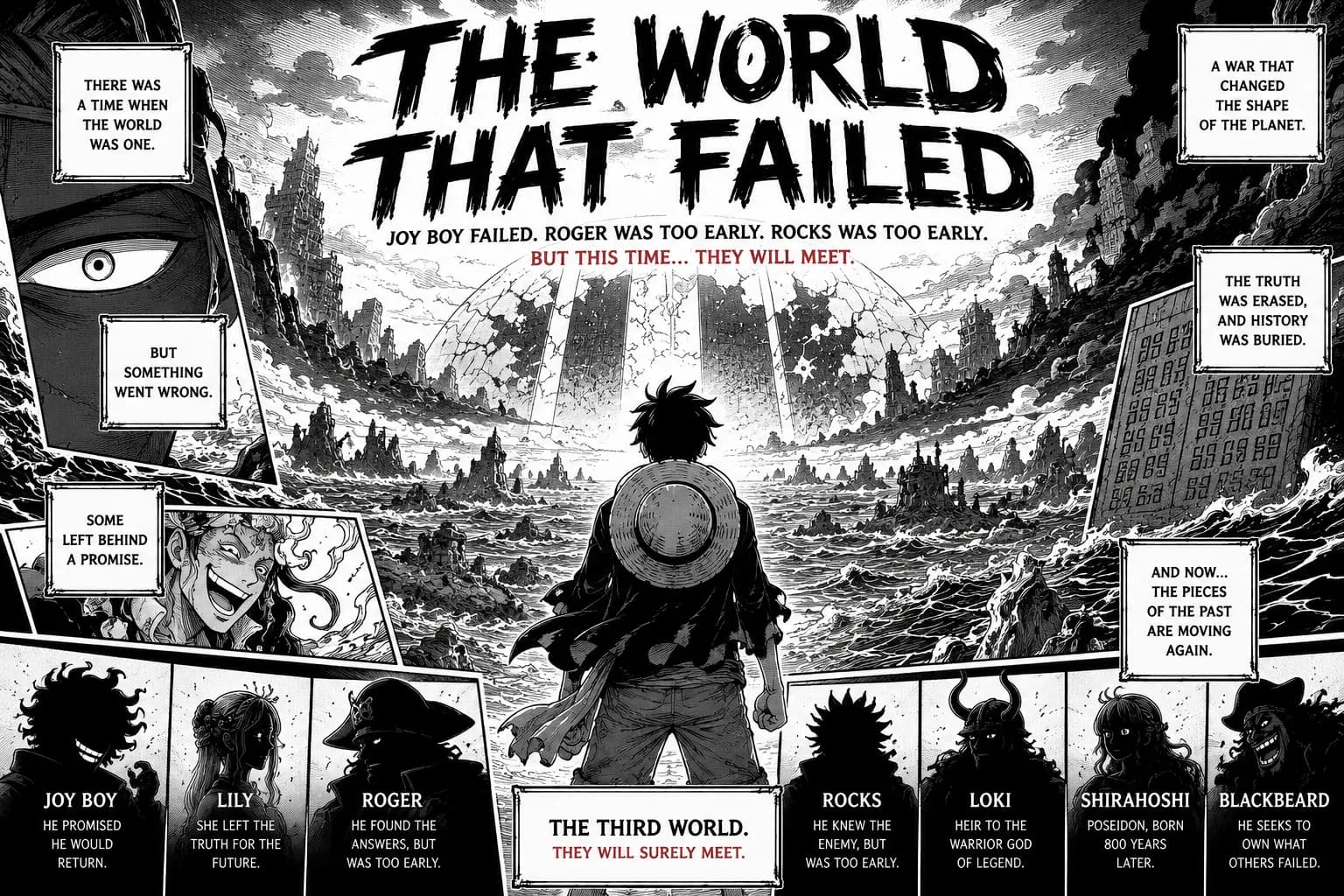
THE FAILED WORLD THEORY
What if the Void Century wasn’t simply the story of Joy Boy versus Imu, but the aftermath of a world-changing failure? The Harley describes three Worlds: two end in separation, while the Third promises that “they will surely meet.” Joy Boy failed. Roger arrived “too early.” Rocks believed he could overthrow Imu, yet was also too early. Meanwhile, Lily preserved the truth, the Ancient Weapons survived, Poseidon was born eight centuries later, and Loki now carries the power of the ancient Warrior God who once fought the Sun God. What if these aren’t separate mysteries? What if history keeps recreating the same failed configuration and Luffy’s generation is the first to bring its missing pieces together?
 Same mystery55% confidenceJoyboy was Binks, the first pirate, and Davy Jones' brother
 Same mystery68% confidenceJoyboy's Downfall was the Nika Devil Fruit
 Same mystery70% confidenceImu created Devil Fruits that prevented people from swimming, so that he could drown powerful people
 Same mystery67% confidenceImu, Joyboy and Davy Jones were brothers!
 Similar argument70% confidenceThe One Piece Treasure is the Sun of the Dawn that can grow the trees that Spawn Devil Fruits from people's imagination
 Similar argument61% confidenceThe One Piece is the return of the Ancient Kingdom!
 Also in this lore84% confidenceMythical Hito Hito no Mi: Model Zaza
 Also in this lore83% confidenceLineage Factor is the sole power system of One Piece and Imu's real weaponAlso in this lore75% confidenceThe Man Marked By Flames Is The Last God's Knight
 Also in this lore27% confidenceThe Egg on Roger's Ship is the LAST Dragon!
What really happened during the Void Century, and why was the world forced to forget it?
For 800 years, the World Government has gone to extraordinary lengths to keep one period of history hidden.
The Void Century.
It isn’t just that the history was forgotten. It was deliberately erased. Ohara was destroyed for studying it. The Poneglyphs were forbidden. The Ancient Kingdom disappeared from the historical record. Even the Will of D, carried by people descended from the enemies of the World Government, became something the Government wanted erased.
That raises a more important question than simply asking who won the war.
What happened during the Void Century that made the truth so dangerous?
I think we have been looking at the Void Century from too narrow a perspective.
Maybe this wasn’t simply Joy Boy versus Imu.
Maybe the Void Century was the second attempt to solve a much older problem.
And if that is true, then the final saga isn’t just history repeating itself.
It may be the first time the world gets a chance to fix it.
1. What Exactly Happened During the Void Century?
Vegapunk has already given us one of the biggest pieces of the puzzle.
The Great War of the Void Century did not simply decide who would rule the world. Its consequences changed the planet itself.
The sea level rose by more than 200 metres. Entire ancient continents disappeared beneath the ocean. The world we live in today is largely what remained after that catastrophe. Vegapunk also establishes that Ancient Weapons were involved in the destruction.
That changes how we should think about the Void Century.
This wasn’t just a war between kingdoms.
The world itself was changed.
And then we get a strange contradiction.
If the Ancient Weapons were responsible for such an enormous catastrophe, why did they survive?
Why would Joy Boy allow these powers to remain in the world?
Vegapunk’s revelations imply that Joy Boy intentionally preserved the Ancient Weapons for the future.
That makes me wonder whether the weapons themselves were never the real mistake.
Maybe the mistake was what the ancient people were trying to do with them.
That distinction matters.
Because if the Ancient Weapons were simply the tools that destroyed the old world, there is no obvious reason for Joy Boy to preserve them.
But if they were tools capable of changing the world, then their destruction or preservation depends on what the next generation intends to do with them.
And that leads to the bigger question:
What was Joy Boy actually trying to accomplish?
2. The Void Century May Not Have Been the Beginning
This is where Elbaf changes the picture.
The Harley is divided into three Worlds.
The First World.
The Second World.
The Third World.
And the first two end with almost the same statement:
They will never meet.
The Third World ends with the exact opposite:
They will surely meet.
That repetition is hard to dismiss as decoration.
The Second World is especially interesting because it contains references to the Void, the Sun God, war, mankind killing the Sun and becoming God, and the Sea God.
Those details fit naturally with the period we associate with Joy Boy and the Void Century.
So one possibility is that the Void Century corresponds to the Second World.
If that’s right, then the Void Century was not the first time the world failed.
It was the second.
And that changes Joy Boy’s role completely.
He may not have created the original problem.
He may have inherited it.
3. The First World
We still don’t know exactly what the First World was.
The Harley gives us fragments.
There was fire within the earth.
Humanity succumbed to greed.
A forbidden Sun was touched.
People were enslaved.
The Sun God appeared.
An Earth God became enraged.
A serpent of hellfire covered the world in death and darkness.
And then:
They never met.
We don’t yet know who these figures represent.
We shouldn’t pretend that the serpent is definitely the Red Line, or that the Sun God must already have been the Nika fruit, or that the First World definitely occurred thousands of years before the Void Century.
Those are separate theories.
But the basic possibility is extremely important:
There was an earlier failure before the Void Century.
If the Second World really is the Void Century, Joy Boy was operating in a world that already carried the consequences of an earlier catastrophe.
That gives us a completely different way to interpret the Great War.
4. The Second World: Joy Boy’s Attempt
The Second World contains the strongest overlap with the Void Century.
There is the Void.
The Sun God.
War.
The Sun being killed.
Mankind becoming God.
The Sea God.
And again:
They will never meet.
This makes me wonder whether Joy Boy was trying to accomplish something that had already failed once before.
Maybe his goal was not simply to defeat the Twenty Kingdoms.
Maybe he was trying to change the structure of the world itself.
And we know that something enormous happened.
The world was flooded.
Ancient continents disappeared.
The Ancient Weapons were used.
Joy Boy lost.
And Imu’s side eventually created the World Government.
The question then becomes:
What did Imu believe had gone wrong?
5. Imu May Have Been an Overcorrection
I don’t think we can honestly reduce the Void Century to:
Joy Boy good. Imu bad.
We know too little about the beginning of their conflict.
What we do know is that Imu was one of the original Twenty and that Imu has preserved the resulting system for eight centuries.
We also know that Imu’s current philosophy is deeply tied to power and domination.
When Imu confronts Loki, Imu describes a chain involving humanity’s desire for strength, corruption and covenants, leading ultimately to domination. Imu then offers Loki the power of a god in exchange for submission and declares domination to be true happiness.
That is not just generic villain dialogue.
It sounds like a philosophy formed from experience.
One possible interpretation is:
Imu saw what happened when humanity was given too much freedom and too much power.
And decided it could never be allowed to happen again.
That does not make Imu right.
It would make the World Government an extreme overcorrection to a real catastrophe.
And that would explain why Imu doesn’t merely want political control.
Imu wants to control history itself.
6. Lily Is the Crack in That System
This is where Nefertari D. Lily becomes extremely important.
Imu tells Cobra that Lily made a mistake that resulted in the Poneglyphs being scattered around the world.
But Imu also questions whether the act was really accidental.
Cobra then reveals Lily’s full name:
Nefertari D. Lily.
Imu also tells Cobra that the truth lies within the letter Lily left behind.
That is a very strange description of someone who supposedly just made an innocent mistake.
Why is Imu still wondering what Lily’s real intentions were 800 years later?
One possibility is that Lily realized what the new order was becoming.
Maybe she didn’t necessarily reject the decision to defeat Joy Boy.
Maybe she rejected what came after.
The World Government wasn’t satisfied with winning the war.
It wanted to make sure nobody could ever reconstruct the war.
And Lily may have made that impossible.
The Poneglyphs survived.
The history survived.
The Will of D survived.
And eventually, Robin arrived.
7. Lily and Vivi
This is where the present begins to mirror the past.
Lily and Vivi share obvious structural similarities.
Both are Nefertari princesses.
Both carry the D.
Both are connected to a kingdom that remained outside the Celestial Dragon system.
Both become connected to the struggle over the world’s true history.
I don’t think that means Vivi is literally Lily reincarnated.
The more interesting possibility is that Vivi represents the same role in a different era.
Lily tried to preserve the future’s ability to choose.
Vivi repeatedly fights for her country’s ability to choose its own future.
We even get a miniature version of this in Alabasta.
Crocodile tries to manufacture a civil war and take over the country.
Luffy defeats him.
But Luffy doesn’t take Alabasta for himself.
He doesn’t become king.
He leaves the country in Vivi’s hands.
That may be one of the earliest examples of the principle that separates Luffy from both Imu and Blackbeard:
he can change the world without needing to own it.
8. Why Was Roger Too Early?
Roger gives us another clue.
He reaches Laugh Tale.
He learns the truth.
He understands Joy Boy.
And yet he realizes that his generation is too early.
The Sea Kings had spoken of future sovereigns, including Poseidon, and Roger understood that the timing mattered.
The obvious explanation is chronological.
I think there may be something deeper.
What if Roger wasn’t simply missing a date?
What if he was missing people?
He had the knowledge.
He had the Road Poneglyphs.
He had reached Laugh Tale.
But the future that Joy Boy’s story depended on had not arrived yet.
So perhaps:
“Too early” means the world was incomplete.
That would make Roger less of a failed successor to Joy Boy and more of a person who finally understood the problem but couldn’t act on it.
9. Three Sun Gods?
This is one of the more speculative parts of the theory, but I think it is worth putting on the table.
The Harley repeatedly features the Sun God.
The First World has a Sun God.
The Second World has the Sun God.
The Third World has the Sun God returning.
The story has also established that Nika’s legend existed in different cultures long before Luffy, while Joy Boy was a historical figure associated with the same power Luffy now carries.
So perhaps the Sun God is not one individual travelling through time.
Perhaps the Sun God is a recurring role or inherited power that appears when each World reaches its crisis.
That would give us a possible pattern:
First World: an earlier Sun God
Second World: Joy Boy
Third World: Luffy
This is absolutely not confirmed.
But if it is true, then Luffy is not simply “Joy Boy 2.0.”
He could be the third attempt.
And that would make the title of this theory much more literal.
The first world failed.
The second world failed.
Now the third world begins.
10. The Ancient Warrior God
Elbaf gives us another possible repeating role.
Chapter 1175 reveals that Loki possesses the Ryu Ryu no Mi, Model: Nidhöggr.
Jarul explains that Nidhöggr was previously wielded by a Warrior God who carried Ragnir and fought the Sun God.
That gives us a very strange current-day parallel:
Luffy is the Sun God.
Loki is the current Nidhöggr user.
The ancient versions of these powers fought each other.
So what if the point is not to recreate that fight?
What if the point is to change the relationship?
The old World gave us:
Sun versus Warrior.
The Third World may give us:
Sun alongside Warrior.
That would fit the Harley much better than another simple hero-versus-enemy cycle.
11. Loki and the Two Sovereigns
The Sea Kings spoke of two sovereigns whose eventual meeting mattered to the future.
The standard interpretation is Luffy and Shirahoshi.
That is still completely possible.
But there is a problem worth considering.
Luffy and Shirahoshi have already met.
They became friends.
Luffy promised to return.
So perhaps Luffy isn’t one of the two sovereigns.
Perhaps Luffy is the person who brings the sovereigns together.
That leads to a more speculative possibility involving Loki.
There is an existing theory that Loki’s mysterious companion Mosa may be Shirahoshi. The evidence is circumstantial and the identity has not been confirmed.
If it turns out to be true, then the Sea and the Warrior have already been connected before either realizes their larger significance.
Then Luffy enters the picture as the Sun.
That would give us:
Sun: Luffy
Sea: Shirahoshi
Warrior: Loki
And suddenly the Harley’s final promise becomes much more interesting.
Maybe “they will surely meet” refers to the forces that repeatedly failed to come together, not simply two named characters.
12. Rocks Was Another Attempt
Rocks gives us a different version of the same problem.
Rocks knew about Imu.
He reached the hidden ruler directly.
And, crucially, he repeatedly tried to recruit Harald. Current material makes it clear that Harald’s strength was important enough to Rocks that Rocks pursued him despite Harald’s refusal.
We cannot prove Rocks knew about Nidhöggr.
But we can establish that he believed Harald himself was important to his plan.
Then the story gives us a very interesting coincidence.
Nidhöggr’s maximum potential is tied to the size of its user, and an Ancient Giant is required to draw out its full potential.
Harald was an Ancient Giant.
Harald’s son Loki eventually becomes the Nidhöggr user.
So there is a possible sequence:
Rocks searches for Harald.
Harald refuses.
Rocks fails.
Harald dies.
Loki inherits the power.
And now that power is standing beside Luffy.
Maybe Rocks wasn’t trying to build a stronger crew.
Maybe he was trying to recreate a specific combination of people and powers that could challenge Imu.
We don’t know that yet.
But that possibility is worth following.
13. Harald’s Failure
Harald’s story strengthens the larger idea.
Harald initially believes that cooperating with the World Government can secure Elbaf’s future.
Instead, the system eventually turns him into a threat to his own people.
When Harald realizes what has happened, he wants Loki to take the legendary fruit and kill him before he can destroy Elbaf.
This is another example of the same problem:
Power is offered as protection.
The person accepts it.
The system takes control.
And Loki inherits what his father could not complete.
That gives us another reason why Imu would be interested in Loki.
Nidhöggr is not simply another powerful Devil Fruit.
It represents a power that Imu recognizes from the past.
In Chapter 1181, Imu even reacts to Loki’s Nidhöggr transformation as something that has returned.
14. So What Was the Void Century Actually About?
At this point, I think we can state the theory much more clearly.
We are not claiming that the Void Century was simply:
Joy Boy wanted freedom and Imu wanted control.
Our claim is:
The Void Century was a second attempt to resolve a much older failure, and the attempt itself became catastrophic.
Joy Boy’s side possessed world-changing power.
The Ancient Weapons were used.
The planet was transformed.
Joy Boy was defeated.
Imu then built a system designed to prevent the conditions of that catastrophe from ever returning.
That system required something more extreme than political control.
It required control over history itself.
Because if people learned how the current world had been created, they might learn that it could be changed again.
That would explain the intensity of the censorship.
15. The Ancient Weapons Were Never Just About Destruction
This is why I think the Ancient Weapons are supporting evidence rather than the centre of the theory.
Poseidon is a person.
Pluton is a ship.
Uranus remains unknown.
Yet all three are classified as weapons because of what they can do.
Nothing in the story establishes that these powers are inherently good or evil.
What matters is who uses them and for what purpose.
And now the final saga is putting three very different attitudes toward power next to each other.
Imu
Power must be controlled.
Blackbeard
Power should belong to whoever can take it.
Luffy
Power doesn’t give you ownership over another person.
These are our interpretations of their behaviour, not philosophies the characters have literally stated in these exact terms.
But the contrast is difficult to miss.
Luffy rejects Pluton’s power when Robin reveals its location beneath Wano.
Caribou, meanwhile, has accumulated information about Poseidon and Pluton and eventually brings it toward Blackbeard’s side.
That turns ancient knowledge into a new source of competition.
16. Why Blackbeard Matters
Blackbeard isn’t just another person racing Luffy for the One Piece.
He may represent what happens when the world’s old powers become available again.
Imu wants the old order preserved.
Luffy may want the old order destroyed.
Blackbeard may want to own whatever replaces it.
That is why Caribou’s information matters.
It isn’t proof that Blackbeard will definitely obtain Poseidon or Pluton.
But it does mean that Blackbeard is being deliberately positioned to receive information about the Ancient Weapons.
And that fits a pattern we’ve seen throughout his story.
Blackbeard doesn’t need to create power.
He finds power that already exists and takes it.
The Yami Yami no Mi.
Whitebeard’s Gura Gura no Mi.
Territory.
People.
Information.
Now potentially the Ancient Weapons.
That makes him the perfect counterpoint to Luffy.
Luffy gathers people.
Blackbeard gathers assets.
17. The Real Failure
So maybe Joy Boy’s defeat wasn’t actually the fundamental failure.
Maybe the failure was that the pieces never came together.
The ancient world had:
the Sun
the Sea
the Warrior
the Ancient Weapons
the people who knew the truth
But they became divided.
The First World ended in separation.
The Second World ended in separation.
And Imu responded by trying to make separation permanent.
That is why the Harley’s final line matters so much.
The Third World is the first one where the story promises something different:
They will surely meet.
18. What Makes Luffy’s Generation Different?
This is where the theory becomes a prediction rather than just an interpretation.
Luffy’s generation has something the earlier generations didn’t have.
The pieces are actually interacting.
Luffy knows Shirahoshi.
Luffy is now working with Loki.
Vivi is connected to the truth Imu wanted erased.
Robin can read the Poneglyphs.
Wano preserves Pluton.
Elbaf preserves ancient mythology.
The Road Poneglyphs point toward Laugh Tale.
Blackbeard is moving toward the ancient powers.
The story is bringing all of these things together in one era.
Maybe that is what Roger was missing.
Maybe that is what Rocks was missing.
Maybe that is what Joy Boy was missing.
Not strength.
Not knowledge.
Convergence.
19. What Does “Too Early” Really Mean?
Perhaps this is the central clue.
Joy Boy failed.
Roger was too early.
Rocks was too early.
All three can be understood as different versions of the same problem.
They were missing part of the configuration.
Joy Boy may have had the power but failed to complete the plan.
Roger had the knowledge but the future had not arrived.
Rocks understood Imu and sought specific allies, but failed to assemble what he needed.
Luffy is entering the story at the exact moment when:
the Sun has returned,
Poseidon exists,
Nidhöggr has returned,
the Poneglyphs still survive,
the truth is resurfacing,
and the old world order is beginning to crack.
So maybe “too early” has nothing to do with the calendar.
Maybe it means:
The world wasn’t ready.
20. What This Theory Predicts
If this interpretation is correct, there are several things we should eventually see.
First, the First World should become clearer. We need to understand what the original failure was and how it led into the world of the Void Century.
Second, the Sun God should have a deeper recurring role. If the three Worlds really represent successive attempts, then Nika should appear as more than one historical manifestation or inheritor.
Third, Loki’s Nidhöggr should connect to the larger ancient conflict.
Fourth, Shirahoshi and Loki may become connected to the same prophecy. If Mosa is indeed Shirahoshi, that relationship could be extremely important.
Fifth, Rocks’ obsession with Harald should eventually make sense.
Sixth, Caribou’s information should matter to Blackbeard’s pursuit of the Ancient Weapons.
And finally, the ending should involve something more than defeating Imu.
It should involve the forces that were previously separated finally coming together.
21. The Weaknesses
There are several places where this theory could be wrong.
We don’t know exactly what the First World represents.
We don’t know whether the Harley’s three Worlds are literal historical cycles.
We don’t know whether the Sun God appeared three times as separate manifestations.
We don’t know who the two sovereigns are.
Mosa may not be Shirahoshi.
Rocks may have wanted Harald simply because of his strength.
And we don’t know exactly what Joy Boy was trying to accomplish.
Those are major gaps.
But the central evidence remains.
The Void Century changed the physical world.
The Ancient Weapons survived.
The truth was deliberately erased.
Lily preserved the Poneglyphs.
Roger reached the truth too early.
Rocks tried to confront Imu before he could complete his plan.
The Sun God has a recurring presence in the Harley.
The Third World ends with a promise that the previous Worlds never fulfilled:
They will meet.
22. THE WORLD THAT FAILED
Maybe this is what the title really means.
The First World failed.
The Second World failed.
Joy Boy was part of the second attempt.
Imu’s answer was to freeze that world in place.
Lily kept the truth alive.
Roger reached the end but came too early.
Rocks understood the enemy but couldn’t complete his attempt.
And now the Third World has begun.
The Sun is here.
The Sea is here.
The Warrior is here.
The Will survived.
The truth survived.
The Ancient Weapons survived.
And for the first time, the people connected to these powers are actually beginning to meet.
Maybe the final question of One Piece isn’t:
Who was right?
Maybe it is:
Can this generation solve the problem that broke the previous two?
Because perhaps the greatest failure of the old world wasn’t that Joy Boy lost.
Perhaps it was much simpler.
They never met.
And this time…
THEY WILL.
Discussion
5 argumentsImu describes Lily’s actions as a “mistake” that caused the Poneglyphs to be scattered throughout the world, but immediately questions whether the scattering was actually intentional. Lily is later revealed to be Nefertari D. Lily. If she deliberately scattered the Poneglyphs, then someone within the founding Twenty may have actively prevented the new world order from completely erasing the history of Joy Boy’s era. This could explain how the truth survived for 800 years despite the World Government’s attempts to suppress it.
Roger and his crew learned about the future birth and maturation of Poseidon and realized that they had reached the end of their journey too early. This establishes that discovering the truth of the world was not enough to complete whatever Joy Boy’s generation had begun. At least one crucial part of the future had to exist before the story could progress. This supports the theory that “too early” may refer not simply to chronology, but to the necessary pieces of the world’s future not yet being in place.
Vegapunk reveals that the Ancient Weapons were responsible for the catastrophe that reshaped the world, yet Joy Boy intended for the weapons to survive beyond the Great War. This creates an important contradiction: if the weapons were simply the cause of Joy Boy’s failure, why would he deliberately ensure that they survived? This suggests that their existence or their future purpose may be more complicated than simply being weapons of destruction.
Vegapunk reveals that the Void Century ended with Joy Boy’s defeat, but the war permanently transformed the planet. The sea level rose by 200 meters, submerging the ancient continents and leaving behind the islands of the modern world. He also states that Ancient Weapons caused this catastrophe and that they still exist today. This establishes that the Void Century was not simply a political conflict it fundamentally changed the physical world and left its destructive mechanisms intact.
The Harley describes three Worlds. The First World ends with “they will never meet.” The Second World also ends with “they will never meet.” But the Third World ends with the opposite: “they will surely meet.” The repeated wording suggests that separation and eventual meeting may be a deliberate structural theme rather than unrelated events. This supports the possibility that the Third World represents an opportunity to resolve a failure that occurred in the previous Worlds.